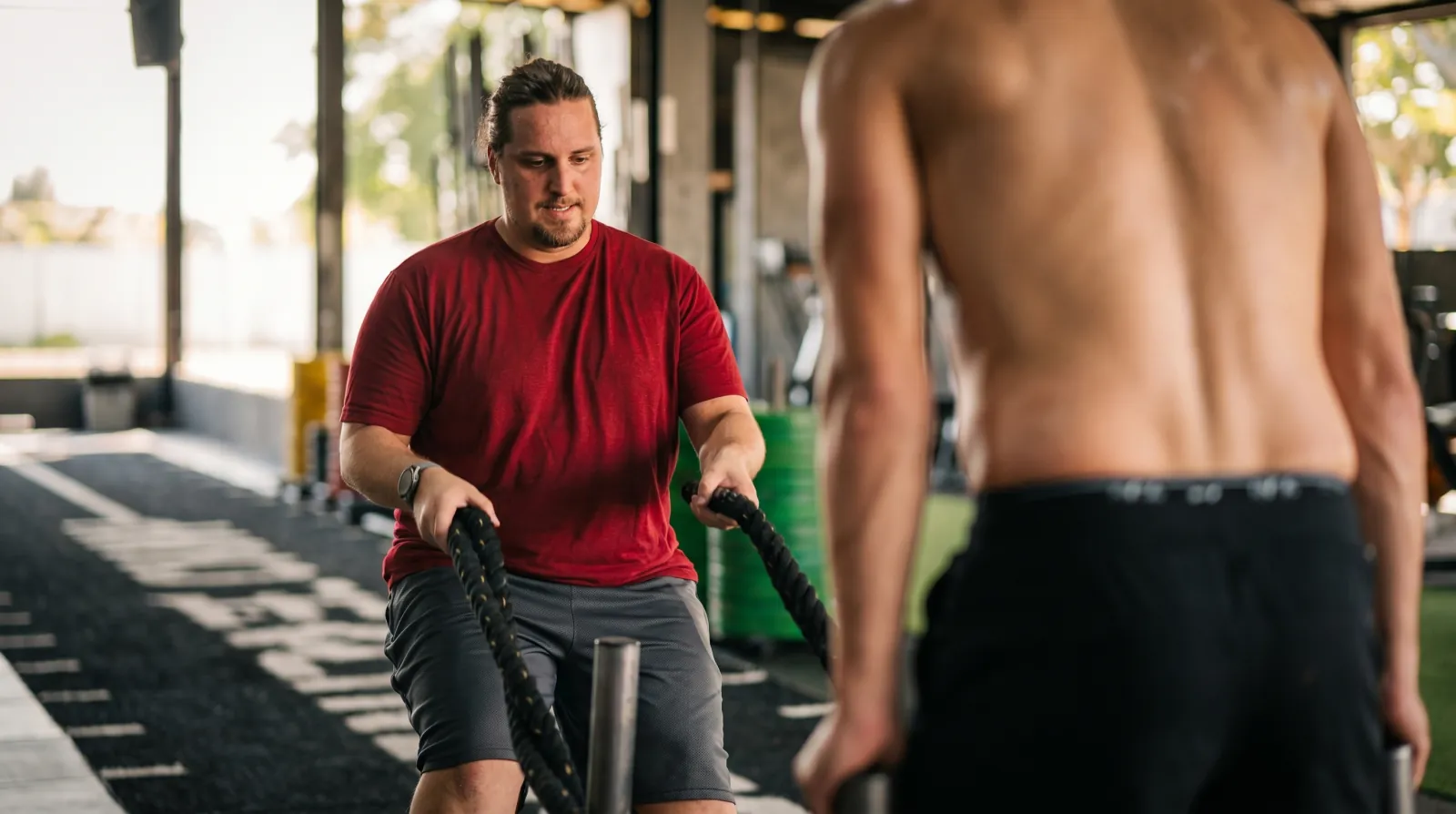
Brian lost 15 kilograms in 15 weeks. If you have spent any time in the weight-loss corner of the internet, that number probably sounds slow. A kilo a week. Nothing that would stop your scroll.
Here is the part the scale never told you: the 15 kilos is the least impressive thing that happened to him.
Brian arrived in Phuket, in his own words, a "very out of shape person, very unfit." He left strong. His cardio was transformed. He had fallen for Muay Thai, a sport he had never tried before. And somewhere in those 15 weeks, while the scale quietly ticked down, his body was doing something the scale is physically incapable of showing you.
This is the story of what that number was hiding, why chasing it is the most common mistake in fitness, and what actually changes when you train for a body that works instead of a number that drops.
Why "a Kilo a Week" Is the Wrong Scoreboard
The scale measures one thing: the total downward pull of your body against the floor. It cannot tell you what that weight is made of. Fat, muscle, water, last night's dinner, the glycogen in your legs, the coffee in your hand. It blends all of it into a single number and hands it to you every morning like a verdict.
The diet industry has trained us to read that one number as the entire scoreboard. It isn't. For most people chasing a real change in their body, it might be the least useful number they track.
Here is the problem with "a kilo a week sounds slow." It assumes every kilo is the same kilo. They are not. A kilo of fat lost while you build muscle and get fitter is a completely different event from a kilo lost by starving and shrinking. Same number on the scale. Opposite things happening inside the body.
Once you see that, "slow" stops applying. A steady kilo a week is the pace experts actually call healthy and sustainable. It only looks slow next to an internet full of lose-it-in-two-weeks promises, and those are the promises that do not hold. What Brian did was never slow, and once you see what was happening underneath the number, it looks like exactly what a real transformation should be.
What a 15kg Drop Can Actually Be Made Of
There is a word for changing what your body is made of, not just how much it weighs: body recomposition. Losing fat and building muscle at the same time. The two move in opposite directions on the scale, which is exactly why the scale gets confused.
Say a person loses 18 kilograms of fat and, by training hard and eating enough protein, builds 3 kilograms of muscle along the way. What does the scale show?
What a 15kg scale drop can actually be
Same number on the scale. Twenty-one kilos of actual change underneath it.
That is the trap of reading the scale alone. A 15kg drop can hide 21 kilos of real change: eighteen gone, three added, pulling against each other. The scale only ever reports the difference.
That is roughly the kind of trade Brian made over his 15 weeks. He did not simply subtract weight from his frame. He rebuilt what his body was made of, which is why he left not just lighter, but visibly and functionally stronger than the man who arrived.
Why Two People Who "Lost 15kg" Can Be Nothing Alike
Picture two people who both step off the scale 15 kilograms lighter than they started.
The first crash-dieted. Big calorie cut, little or no training, all of it driven by the morning weigh-in. When you lose weight that way, a meaningful chunk of it is not fat. It is muscle and water. They end up lighter, yes, but softer, weaker, and with a metabolism that has quietly downshifted to defend against the shortage. The body they have now burns less, holds less shape, and is primed to regain the moment normal eating resumes.
The second trained. They lifted, they moved, they ate enough protein to give the body a reason to keep its muscle and build a little more. Their 15kg is mostly fat, offset by new muscle. They end up lighter and stronger, with better cardio, a higher resting metabolism, and a body that holds its result because it was built, not starved.
Identical number. Opposite bodies. Opposite futures. This is the single most important thing the scale will never tell you, and it is the entire reason we do not let guests measure their progress by it alone.
The science
Muscle is metabolically active tissue: it costs energy to carry, so more of it raises the calories you burn at rest. In a calorie deficit, your body will happily break down muscle for fuel unless you give it two clear signals to keep it: enough protein, and a reason to need it, which is resistance training. Diet alone tells the body to get smaller. Training tells it which parts to keep. That is why the variable that decides whether your 15kg is mostly fat or partly muscle is not how little you eat. It is whether you train.
Brian's Story: From Very Unfit to Genuinely Fit
Brian came to Prime Revive from Sarasota, Florida, and stayed for 15 weeks. He was clear-eyed about why he chose a structured retreat over another go at it alone, and his reasoning is the whole point of this article:
"I was looking at a lot of different retreats, and this one offered the best mix of actually trying to get you in shape instead of just focusing on weight loss, and really trying to change your lifestyle more than just the quick fix of 'let me get skinny quick.' I don't really believe in the methodology of that."
He arrived unfit and said so plainly. What he did not expect was the room he walked into:
"Coming here, I was a very out of shape person, very unfit. Everyone was super friendly and supportive of me and my journey. No one was exclusive. Everyone wanted me to come along and supported me the whole way."
Somewhere in the first few weeks he found the part of training he did not know he was missing. For Brian it was Muay Thai, something he had never done in his life:
"My favourite workout was the Muay Thai. Never did it before, but I'm a huge fan now. I'm definitely going to keep it up when I go back home."
By the end, the headline number was 15 kilograms. But ask Brian what changed and the scale is not where he goes first:
"I lost over about 15 kilos. Very happy with that. But the biggest thing is I'm in much better shape. My cardio is way better. Just moving around, everything is much easier, and I'm much happier with who I am and the kind of person I've become during my stay here."
"The kind of person I've become." That is not a sentence about a number on a scale. That is what happens when the goal is the body and the life around it, not the weigh-in.
Why the Quick Fix Feels Good and Fails Anyway
The promise of "lose 10 pounds in two weeks" is everywhere because it sells. It scratches a real itch: we want the result now, and we want proof on the scale by Friday. The trouble is that the fast number is mostly the wrong stuff.
Rapid early weight loss is largely water and glycogen, with muscle close behind. It comes off fast and comes back faster, because nothing underneath actually changed. You did not build a body that holds the result. You rented a smaller number for a couple of weeks and paid for it with muscle, energy, and the metabolic capacity you will wish you still had when the weight returns. We see the aftermath constantly: people who have lost the same 10 pounds five times and are weaker each round.
Brian had clearly met that pattern before, which is why his recommendation comes with a filter on it:
"If you're out here just to get your quick fix of 'let me lose 10 pounds in two weeks,' it might not be for you. But if you're really trying to change your lifestyle, this is a really good place to go and learn how to live your life better. You'll be set up for a healthier future."
That is the honest line, and it is worth taking from a guest rather than from us. A real transformation is not a sprint you survive. It is a foundation you build and then keep standing on.
Training for a Transformation, Not a Number
Here is the reframe worth holding onto. Stop training to make the scale go down. Start training to make your body work better: stronger, fitter, more capable, more resilient. Train for function, and the fat loss arrives as a byproduct of becoming a different kind of body, rather than the whole anxious point of every meal.
Picture the version of you that did it that way. You can climb the Big Buddha hill without stopping halfway. You can hold pads through a Muay Thai round and enjoy it. You carry the shopping, the kids, the day, without it costing you. You have energy in the afternoon. And the habits that got you there are simple enough to survive the flight home, which is the only test that actually matters.
That is the thing worth wanting. Not a number you have to defend by eating less forever, but a body and a set of habits that make the number almost an afterthought. Brian put it in five words: the kind of person he became.
How Prime Revive Is Built for This
Everything about the program is designed to make the right kind of 15 kilos, the recomposition kind, instead of the crash-diet kind.
You train, properly and often. Strength, conditioning, 1-on-1 Muay Thai, beach workouts, the Big Buddha hike, and two personal training sessions a week. A Prime Revive coach is at every session, at a 1:4 coach-to-guest ratio, watching your form and pushing the right amount. That training is the signal that tells your body to keep its muscle while the fat comes off.
Your nutrition is built to protect muscle, not just cut calories. Through our Pure Prep partnership you get two calorie- and macro-counted meals a day, a protein shake, and a snack, with protein deliberately prioritised so the deficit takes fat and leaves muscle. Your evening meal is yours to choose within your remaining targets, so you build habits you can actually keep.
Recovery is scheduled, not optional. Weekly sports massage, ice bath, sauna, yoga, and active recovery. Recovery is not the soft option. It is what lets you train hard for weeks at a time instead of burning out in the first one.
And we measure the thing that actually matters. Every week you get a 3D body composition scan and a one-on-one review with the head coach, who walks you through the data and adjusts your nutrition where needed. That is how you see fat going down and muscle holding or climbing, the full picture the bathroom scale will never give you. It is also why a stalled scale almost never means stalled progress.
The documented results follow from this approach, not from extreme dieting: 8kg in 4 weeks, 10kg in 8 weeks, 20kg in 12 weeks, all with training and composition tracking built in. See more guest transformations, or read how Adam lost 16.5kg and Sonny lost 7.3kg the same way. Our standard is simple: if you can walk, you can start, whatever shape you are in today. Brian is proof of that.
If you want to see how it fits together, here is how the retreat works, what a longer stay looks like on the 12-week body transformation, and the shorter 4-week programme. New to all of this? Start with the beginner-friendly retreat.
What to Realistically Expect
Honesty is part of the method, so here is the realistic version. Healthy weight loss runs at roughly 0.5 to 1 kilogram per week (the CDC's range), and the rate can be higher early on for guests carrying more weight to start. Brian's pace, around a kilo a week sustained over 15 weeks, is exactly what good, durable progress looks like.
Expect the scale to lie to you in both directions: weeks where it stalls while your body fat is dropping, and weeks where it drops fast because of water rather than fat. That is why we track composition, not just weight. Expect it to take weeks, not days. And expect to leave with a foundation, not a finish line, because the entire point is a change that keeps going after you fly home.
If that is the kind of transformation you actually want, the slow-built, strong-finishing, stays-with-you kind, that is the only kind we know how to build. Tell us your goals and get a free personalised plan, no commitment, and we will show you exactly what your version of it could look like.
FAQ: Body Recomposition and Training for Fat Loss
What is body recomposition?
Body recomposition means losing fat and building muscle at the same time, so you change what your body is made of rather than just how much it weighs. Because fat and muscle move in opposite directions on the scale, recomposition often makes the scale move slowly even when your body is changing dramatically. It is best tracked with body composition scans and photos, not weight alone.
Can you build muscle and lose fat at the same time?
Yes, especially for people who are new to training or returning after a long break, and for those carrying excess body fat. The combination that makes it possible is enough protein, consistent resistance training, and a moderate calorie deficit. It is harder for very lean, advanced trainees, but for most people starting a transformation it is exactly what should happen.
Is losing about 1kg a week good progress?
Yes. Roughly 0.5 to 1kg per week is the range health authorities including the CDC consider healthy and sustainable, and it can be higher early on for people with more weight to lose. A slower, steadier pace also tends to preserve more muscle, which is what makes the result last. Brian lost around 15kg over 15 weeks, almost exactly a kilo a week.
Why is the scale a bad way to measure progress?
The scale reports total body weight as a single number and cannot distinguish fat from muscle, water, or food. Two people who both lose 15kg can have completely different bodies depending on whether they lost fat or muscle. Progress photos, how your clothes fit, strength and fitness markers, and especially body composition scans give a far more accurate picture than weight alone.
Do I need to lift weights to lose fat, or is dieting enough?
Dieting alone will lower the number on the scale, but a significant portion of that loss can be muscle, which leaves you lighter but weaker and more likely to regain. Resistance training signals your body to keep its muscle while the fat comes off, so you end up stronger, fitter, and with a higher metabolism. Training is the variable that decides what kind of weight you lose.
How long does a real body transformation take?
A meaningful, durable transformation is measured in weeks and months, not days. Most Prime Revive guests stay between 1 and 12 weeks, with 4 weeks being the most common and longer stays producing the largest changes. The goal is not a quick number but a foundation of strength, fitness, and habits you can maintain long after the retreat ends.