
In a Cochrane review of 43 studies, adding exercise to a diet produced about 1.1kg more weight loss than the diet alone. So why does our weight loss week in Phuket hold 12 training sessions?
Because the scale is only one of the jobs. We treat food as the main lever on your weight, and training as the work food cannot do.
Below is the example week we publish for Prime Revive, session by session, with the reason each piece is there. We are in Chalong, Phuket. Stays run 1 to 12+ weeks, the most common stay is 4 weeks and prices run £700 to £1,250 a week. You do not need to book with us to use the logic.
What does exercise actually do for weight loss?
For the number on the scale, less than most people expect.
The Cochrane review found that exercise produced small weight losses compared with no treatment. Harder exercise did more than easier exercise, by about 1.5kg. That is real, but it is small.
The same review also found changes the scale never shows. Even as the only intervention, exercise reduced diastolic blood pressure, triglycerides and fasting glucose.
So we think about it this way. Food sets how fast the weight moves. Training decides what you keep while it moves, and how capable you are at the end.
What does a coached week look like, day by day?
This is the example week from our retreat page. The massage is yours to book whenever works, so it could land on a different day.
- Monday: 09:30 interval training at Pirate Camp. 15:00 lower body strength at Kong.
- Tuesday: 08:30 Big Buddha hike. 15:00 upper body strength at Pirate Camp. 17:30 deep tissue massage.
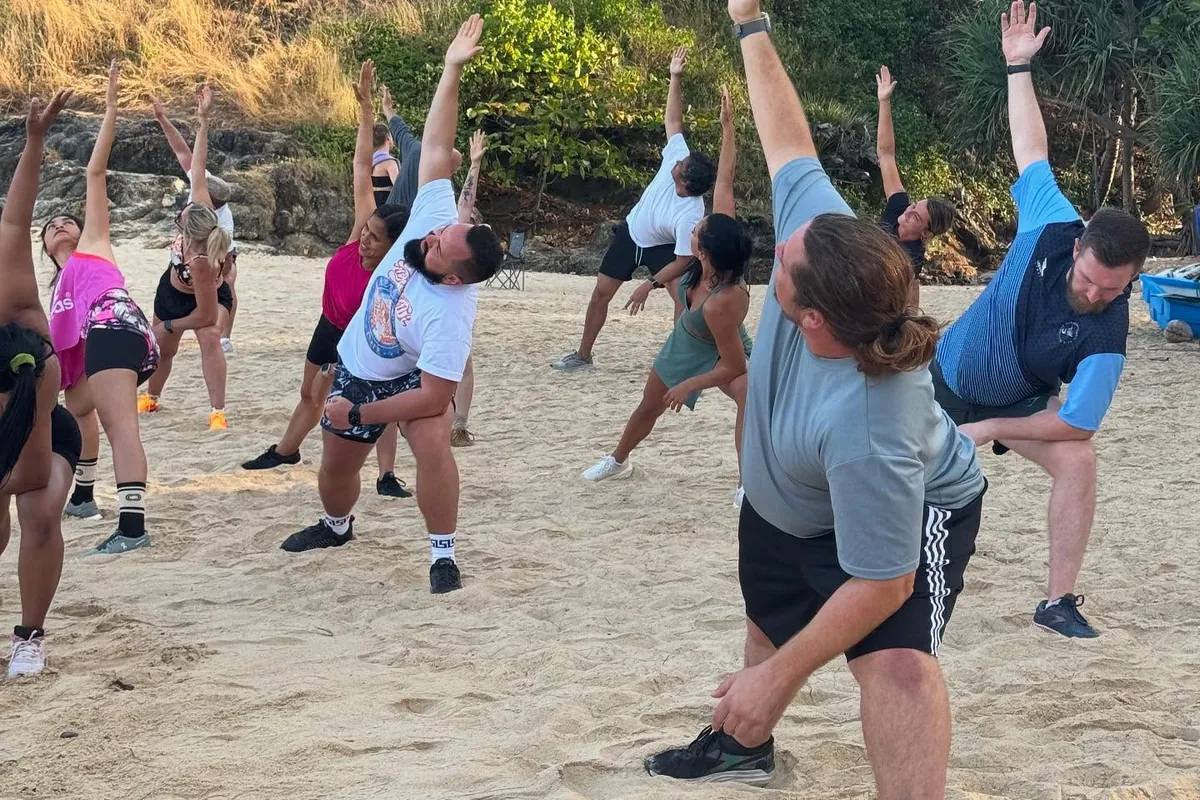
- Wednesday: 07:00 group beach workout at Yanui Beach. 14:00 HardCORE Abs at TIGER. 16:00 personal training at Primal Gym.
- Thursday: 09:30 team workout at Pirate Camp. 17:00 personal training at Primal Gym. 18:30 yoga at Yoga Connections.
- Friday: 08:30 group hike. 14:00 private Muay Thai at Apollo Gym. 17:30 group ice bath at 5 Elements.
- Saturday: 08:30 weekly body scan. 09:30 interval training at Pirate Camp. 11:00 breakfast and a one-to-one review with your coach.
- Sunday: rest day. Explore the island or stay in.
Count it up and you get 12 training sessions, three recovery sessions, one scan, one review and one full rest day.
How much training do you actually need?
Less than this, if your goal is general health.
The NHS guidelines for adults aged 19 to 64 ask for at least 150 minutes of moderate activity or 75 minutes of vigorous activity a week, plus strengthening activities on at least 2 days, spread across 4 to 5 days or every day.
Our week goes well past that on purpose, because you are here to train and a coach is in the room. We would not tell anyone to copy 12 sessions at home with nobody watching. If you are starting alone, start with the NHS numbers and build.
Why is strength training at the centre of a weight loss week?
Because dieting without it can cost you muscle.
A meta-analysis of six randomised trials looked at older adults with obesity who cut calories. Those who also did resistance training three times a week, for 12 to 24 weeks, avoided 93.5% of the lean mass loss that came with calorie restriction, about 0.8kg. Their fat loss did not differ significantly from the diet-only groups.
That is one population, not everyone. But it is why our week does not read like a cardio list. Lower body strength lands on Monday, upper body strength on Tuesday, and personal training on Wednesday and Thursday. Loads and movements are adjusted for injuries and mobility, which is where coached training and a bootcamp part ways.
Why do intervals and hikes share the same week?
Because neither one wins outright.
A meta-analysis of 13 trials in overweight and obese adults aged 18 to 45 compared high-intensity interval training with moderate continuous training. Both produced modest body composition improvements, without accompanying changes in body weight, and the two were similarly effective. The authors suggested interval training may be the time-efficient option.
So we use both. Interval sessions sit on Monday and Saturday. On Tuesday and Friday you leave the gym and head outdoors.
Outdoors is not the easy option. Here is Fiona on the Big Buddha hike:
When I did that Buddha hike, I thought I was going to like really pass out, but you guys were there.
Where does recovery fit when you train this much?
On the calendar, in the same place as the training.
Hard training only pays off when your body can absorb it. So the example week holds a deep tissue massage, a yoga session and an ice bath, and Saturday afternoon and Sunday stay free. Longer stays add planned deload weeks, where training volume drops. If you want to know what the evidence does and does not support, we wrote up ice baths and sauna separately.
One guest from Ireland, three weeks into a stay, put the point better than we can:
My biggest lesson learned is about showing up. It's not about maxing everything out every day. It's about being here and about consistency.
What does the Saturday scan and review do?
It turns a hard week into information you can act on.
A systematic review of 22 studies found a consistent link between self-monitoring and weight loss. The authors rated the evidence as weak, and a link is not proof of cause. We still think being measured and talked through it each week earns its slot.
In the example week, Saturday opens with your 3D body scan and moves on to a one-to-one review with your coach. Any single reading moves with water, food and sleep, so one scan tells you little. We read the trend across your weekly scans, and that trend is what the conversation is about.
What happens with food between the sessions?
Given what that Cochrane review found, we treat this as the biggest lever on the scale.
Two meals, a shake and a snack are included, all from Pure Prep, and they are calorie counted and macro tracked. The evening meal is not included. It is yours to choose, with clear calorie and protein targets, and most guests keep it simple with protein and vegetables.
We think that gap is useful. Dinner is the meal you practise choosing for yourself.
Who is this week wrong for?
If you want to lose weight while training as little as possible, this is not your week. If 12 sessions reads like a punishment rather than a challenge, start smaller. If you have a medical condition or an injury, speak to your doctor before you start any new programme.
How does Prime Revive run this week?
The sessions above are the structure of our weight loss retreat in Phuket on Soi Ta-iad, known as Fitness Street. There is one coach for every four guests, and a coach attends every session.
Dmitry, four weeks in, liked how little there was to decide:
You don't have to think much about all of the stuff. You've got all of the training schedule. You've got all of the nutrition plan. You've got recovery activities.
If that sounds like what you need, see the full programme and what a stay costs, or apply here and tell us where you are starting from. If you would rather build it yourself, take the order of priorities above: food first, strength next, recovery on the calendar, and a measure you check every week.
Questions people ask
How many training sessions are in a week at Prime Revive?
Our published example week has 12 training sessions, three recovery sessions, one 3D body scan, one review with your coach and one full rest day on Sunday.
Does exercise on its own cause weight loss?
A Cochrane review of 43 studies found that exercise produced small weight losses compared with no treatment, and that adding exercise to a diet produced about 1.1kg more weight loss than the diet alone. Exercise still reduced diastolic blood pressure, triglycerides and fasting glucose.
Are all meals included at Prime Revive?
No. Two meals, a shake and a snack are included. The evening meal is yours to choose, with clear calorie and protein targets.
Sources
- Exercise for overweight or obesity (Shaw et al., 2006), Cochrane Database of Systematic Reviews
- Physical activity guidelines for adults aged 19 to 64, NHS
- Resistance training prevents muscle loss induced by caloric restriction in obese elderly individuals (Sardeli et al., 2018), Nutrients
- The effects of high-intensity interval training vs. moderate-intensity continuous training on body composition in overweight and obese adults (Wewege et al., 2017), Obesity Reviews
- Self-monitoring in weight loss: a systematic review of the literature (Burke et al., 2011), Journal of the American Dietetic Association
How this article was made: written with AI assistance from Prime Revive guest video interviews and the published research listed above. Every fact links to its source, and guest quotes are word for word from their interviews.