Most people who try to get in shape on their own don't quit because the training is too hard. They quit because nothing absorbs it. The soreness stacks up, the sleep gets thin, a small ache becomes a real one, and by week three the body says no. That is not a willpower problem. It is a recovery problem, and it is the part of the plan almost nobody schedules.
This is the case for deliberate heat and cold as actual recovery, not a spa nicety. It is also an honest accounting of what the ice bath and the sauna really do, what they don't, and why we put them on the calendar at Prime Revive instead of leaving them to chance. If you read to the end and decide to build your own recovery rhythm at home with nothing but what you learn here, good. You will have what you need.
The reason past attempts fell apart
Think back to the last time you trained hard for a stretch of weeks. The first ten days felt great. Then the fatigue started to compound. You were sore before the next session even began. You started skipping. You told yourself you were being lazy.
You probably weren't. You were carrying recovery debt.
Training does not make you fitter. Training plus recovery makes you fitter. The session is the stress; the adaptation happens in the hours and days after, while you rest, eat, and sleep. Push hard with nothing to absorb the load and the stress just accumulates. Soreness, poor sleep, irritability, niggling joints, a flat feeling in every workout. That is the wall most home attempts hit, and it has a name in the literature: training load that outruns recovery.
Heat and cold are two of the oldest tools for managing that load. The trick is knowing exactly what they buy you, because the internet has badly oversold both.
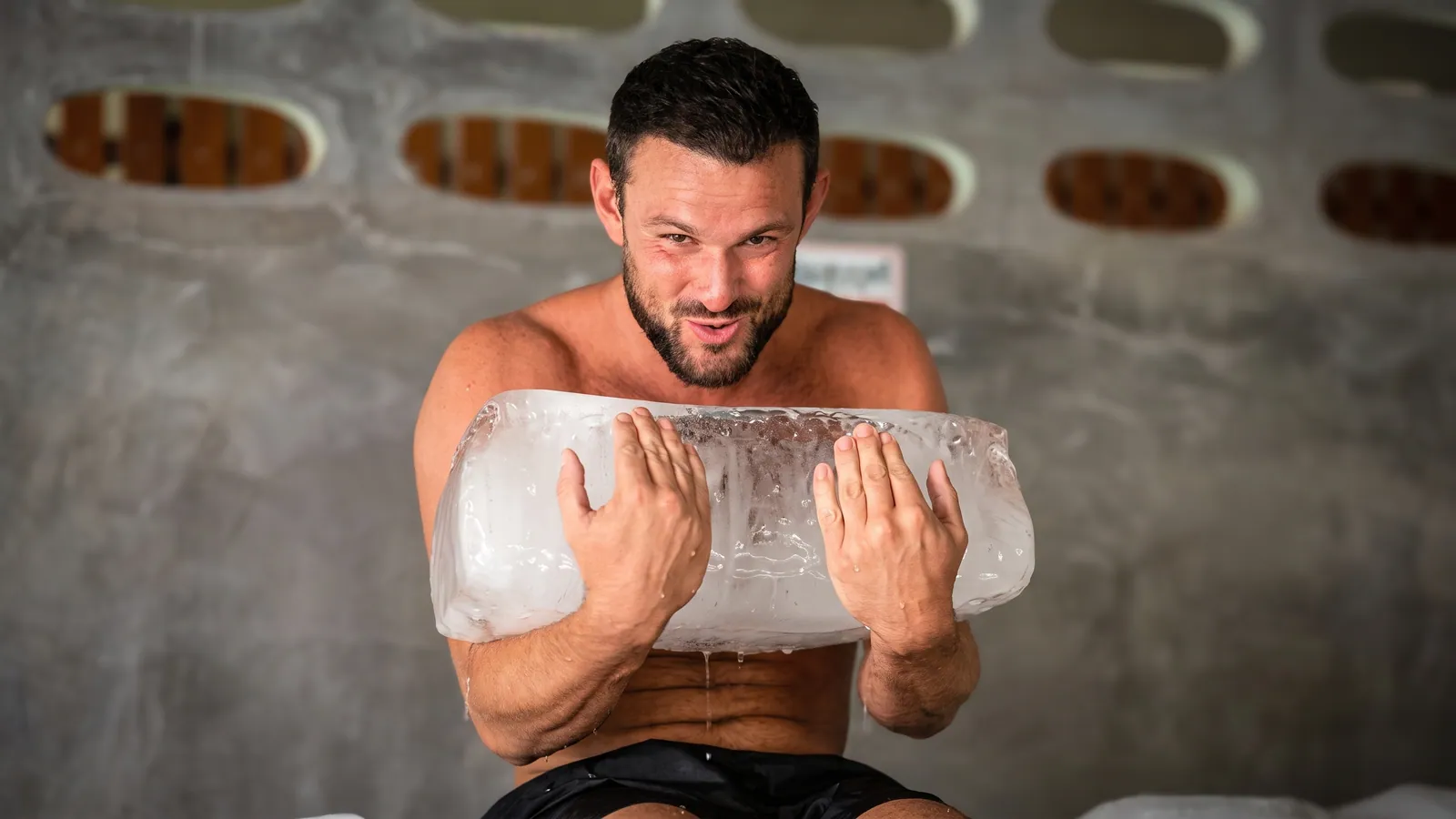
What an ice bath actually does
Let's be blunt about how this looks from the outside. A grown adult lowering themselves into freezing water for a few minutes, breathing like they're giving birth, then claiming it changed their life. It reads like a gimmick. A lot of what gets said about it online is one.
Here is what the evidence actually supports.
Cold-water immersion reliably reduces how sore and how fatigued you feel in the first 24 hours after a hard session. That is the strongest, most repeatable benefit. A network meta-analysis points to medium-temperature, medium-duration exposure (roughly 10 to 15 minutes at around 11 to 15C) as most effective for next-day soreness. (source) In the broader soreness literature, that relief is mostly an early-window effect rather than something that carries on for days.
It also helps with stress, on a delay. The best recent synthesis, a 2025 review of 11 trials and over 3,000 people, found a large drop in stress around 12 hours after cold exposure, not in the moment. (source) So the calm you've heard people describe is real, but it shows up later, not while you're gasping in the tub.
Now the honest part, the part most fitness content skips because it complicates a clean story.
An ice bath taken immediately after heavy resistance training can slightly blunt muscle growth. A 2024 systematic review of eight studies found that post-workout cold-water immersion modestly reduces hypertrophy compared to training alone, by suppressing the anabolic signalling that tells a muscle to get bigger and by limiting the very inflammation you were trying to soothe. (source) Earlier controlled work found the same: cold plunging right after lifting dulled the muscle-building response, although it did not clearly hurt strength gains. (source) The size penalty is clearer than the strength penalty.
This is the single most useful thing to understand about cold, and it is why timing matters more than temperature.
And the things ice baths are most loudly sold for? Mostly not true.
Does a cold plunge burn fat? Cold genuinely activates brown fat and bumps your energy burn a little. But there is no good evidence that cold plunging causes meaningful fat loss on its own, and some studies even showed fat mass going up. (source) It is not a weight-loss tool.
Immunity. Acute immune markers don't move reliably after cold exposure. One cold-shower trial found people took fewer sick days off work, though it found no difference in the actual number of days people reported being ill. Suggestive, not settled. (source)
Testosterone. The popular claim is backwards. Cold immersion after lifting actually blunted and delayed the normal post-workout testosterone rise in at least one study. (source)
So the ice bath is not magic. It is a precise tool for one job: making you feel less wrecked so you can train again sooner. Used at the wrong moment, it can quietly work against the muscle you're trying to build. That is exactly why it should be programmed, not improvised.
What the sauna actually does
Heat has the more impressive long-term data, and it comes with its own caveats.
The headline study is a Finnish cohort of over 2,300 middle-aged men tracked for around two decades. The men who used a sauna four to seven times a week had substantially lower risk of fatal heart disease and lower all-cause mortality than once-a-week users, in a clear dose-dependent pattern. (source)
That is a genuinely striking finding, and it deserves an honest frame. It is observational. It shows association, not proof that the sauna caused the longer life. It is one population of older Finnish men, and frequent sauna users may simply have been healthier or wealthier to begin with. "Associated with" is the truthful phrasing. "Will make you live longer" is not.
For recovery specifically, the evidence for heat is thinner and more mixed. Some studies show better perceived recovery after sauna, but the effect on soreness is inconsistent, and the reviews stop short of a firm conclusion either way. (source) The same review carries a clear caution: a long, hot traditional sauna right before a next-day maximum effort can actually impair that performance. Heat, like cold, is not free if you stack it carelessly against hard training.
So which is better, ice or heat or both?
The honest answer disappoints people who want a winner.
Contrast therapy, alternating hot and cold, does beat passive rest. It reduces soreness and perceived fatigue and helps clear the markers of muscle damage. (source) What the meta-analyses do not show is contrast therapy being clearly better than cold alone. "Better than doing nothing" is well supported. "The single best recovery method" is not a claim the science backs.
That is the through-line across all of it. Cold, heat, and contrast all beat passive rest for how you feel and how fast you bounce back. None of them is a miracle, and at least two of them can interfere with training adaptations if you apply them at the wrong time. The value is not in any single plunge. It is in using the right tool, at the right moment, week after week, so the training actually compounds.
Which is a scheduling problem. And scheduling is the thing willpower is worst at.
How Prime Revive is built for this
At Prime Revive, recovery is not an add-on you book if you feel like it. It is one of our four pillars, alongside Training, Nutrition, and Accountability, and it is written into the structure of your week.
The weekly recovery rotation includes sports massage, ice bath, sauna, yoga and stretching, and active recovery like a hike or a kayak. None of it is left to chance or squeezed in when you feel like it. It is scheduled into your week like any training session. For longer stays, we periodise deload weeks, deliberately lighter stretches that let the adaptations catch up to the work.
The point of putting it on the calendar is that the calendar makes the decision you would otherwise skip. You train hard, week after week, because the recovery is already there to absorb it. The soreness that ended your last attempt gets managed instead of stacked. And because the whole week is coached, recovery and training are planned together rather than colliding by accident. The research says timing matters; a structured week is how you get more of it right without having to think about it.
Picture the difference. At home, recovery was the thing you meant to do and never did, and the wall arrived on schedule. Here, you step out of the ice bath loose instead of dreading the next session, you sleep, you eat real food prepped for you, and you wake up able to train again. You finish the block strong because you recovered like an athlete, which is the only reason anyone gets to keep training like one.
One more thing the marketing usually skips: cold and heat are not risk-free, which is why we run them as scheduled sessions built into a coached, structured week rather than a solo experiment you improvise at home. Cold immersion carries real acute risk. The cold-shock gasp reflex is the most dangerous moment and a genuine drowning hazard, and sudden cold puts a sharp load on the heart and can spike blood pressure. (source) It is higher-risk or off-limits for people with heart disease, uncontrolled high blood pressure, a history of stroke, or during pregnancy, so if any of that is you, clear an ice bath with your doctor first. Heat carries its own load: dehydration and heat stress, which matter even more in Phuket's climate. None of that means avoid these tools. It means use them with eyes open, which is easier when they are part of a coached, structured week instead of a solo experiment.
The honest bottom line
Ice baths and saunas are not the reason anyone transforms their body. The training and the food are. But recovery is the reason you get to keep training long enough for the training to work. Used honestly, cold takes the edge off the soreness and the stress, heat carries some real long-term upside even if its short-term recovery effect is mixed, and a structured week makes sure neither one quietly sabotages your results.
If everything you just read is enough to build your own recovery rhythm, take it and use it. If what you actually want is to train hard for weeks without breaking down, in a place where the recovery is already scheduled so you only have to show up, that is exactly what we built.
Tell us your goals and we'll send you a free personalised plan, no commitment. See how the week is structured at our Phuket fitness retreat, read real guest transformations, or apply here to start.
Specific guest results referenced anywhere on this site are individual cases, not predictions or averages.