You did not lack discipline. You were losing a daily fight against your own kitchen, your own desk, the same sofa at the same hour, the mates who order the second round, the weather that gives you a reason to skip. Willpower never lost to weakness. It lost to a room it walked into every single day. That is not a character flaw. It is a feature of how human behaviour actually works, and it is the single most overlooked reason your last attempt died at home.
You did not fail. Your environment won.
Here is something the fitness industry will not tell you, because it does not sell a clean before-and-after photo: roughly 45% of what you do in a day is not a decision. It is a cue. Your brain runs on autopilot, triggered by the physical context around you, the time on the clock, the place you are standing, the people in the room. Researchers call these context cues, and they fire whether you want them to or not.
Wendy Wood, a behavioural scientist who spent decades studying habits, found that when the cues stay the same, the behaviour stays the same. The fridge at eye level. The drawer with the snacks. The route home that passes the place you always stop. You can summon willpower for a week, maybe three, but you cannot out-discipline an environment that is quietly cueing the old behaviour a hundred times a day.
This is why most home resets fail in week four. Not because you are weak. Because nothing around you changed, so everything around you kept asking you to be the person you have always been.
And it is why one of the most reliable windows for actually changing a habit is the one almost nobody plans for on purpose: removing yourself from the context entirely. The research has a name for it, habit discontinuity. When you relocate, when you travel, when the physical cues disappear, the autopilot breaks. For a short, precious window, your behaviour is back under conscious control, and new habits install far more easily than they ever would at home.
That is the real argument for doing a reset abroad. Not the beach. Not the photos. The cue-break.
What a full environment swap actually changes
Let me be honest about the thing you are probably thinking, because the skeptical version of you is the one worth convincing: "Going abroad to get fit sounds like an excuse to take a holiday and call it self-improvement."
Fair. Most of the time it is exactly that. A spa week with a green smoothie on day one and room service by day three. The difference is not the plane ticket. The difference is whether the new environment removes the decisions that defeated you, or just relocates them somewhere prettier.
A real reset environment does one job: it takes the hundred small daily decisions that willpower keeps losing and makes them for you, in advance.
What is for breakfast. Decided. When do I train. Scheduled. What do I cook tonight. Handled. Do I go for the run or stay in. There is no "stay in" version of the day. The path of least resistance, the thing you do on autopilot, is now the thing that moves you forward instead of the thing that holds you back.
That is the mechanism. Not motivation. Not paradise. You stop spending willpower on logistics and temptation, and for the first time the easy choice and the right choice are the same choice.
The reason this matters more than another book or another app: you are not trying to become more disciplined. You are trying to spend a few weeks somewhere that does not require the discipline, so the new behaviours become automatic before you go home and the old cues come back.
Why Phuket, and not just "somewhere warm"
There are warm places everywhere. Phuket earns the specific recommendation for reasons you can verify, not adjectives.
It is built for getting in shape, not for getting a tan. Phuket has a street that exists for one reason: training. Prime Revive is based on Soi Taied, which everyone who trains here just calls Fitness Street. Inside one walkable strip you have serious gyms, coaches, recovery facilities, and our nutrition partner Pure Prep, all minutes from each other. Few places in the world concentrate that much of the actual work of a body transformation into a single location. We do not bolt one gym onto a resort and call it a programme. We run your week across the real venues on that street, so the whole environment is built to move you toward the one thing you came for.
It is genuinely easy to get to. Phuket International Airport is Thailand's third-largest, with non-stop flights to around 72 destinations across 35 countries on roughly 62 airlines. In February 2026 it set a single-day record of about 71,613 passengers. This is not a remote outpost you fight to reach. It is a major Southeast Asian gateway, which matters when the whole point is to lower the friction of leaving home.
It is cheap enough to make the reset rational. Living costs in Thailand run roughly half of US, UK, and Western European equivalents, with rent dramatically lower. Across the wider retreat industry, a seven-day program commonly falls anywhere from a few hundred to a few thousand dollars depending on tier. Those are industry-wide ranges, not anyone's specific price, but the point holds: your money goes substantially further here than it does at home, which is exactly why Thailand has become one of the fastest-growing major wellness destinations on earth. According to the Global Wellness Institute, Thailand's wellness tourism market was worth 14 billion dollars in 2024 and grew 36.4% year on year, roughly three times the global average.
So the warm climate is the least of it. Phuket gives you authenticity, access, affordability, and terrain, in one place, which is why it has become one of the densest fitness and wellness hubs in Asia.
The honest weather guide
We run 365 days a year, so any date works. But "any date works" is not the same as "every date is identical," and I would rather tell you the truth than sell you a postcard.
Phuket sits at around 28C on average all year. The seasons split roughly like this:
Dry season, around December to March. This is the northeast monsoon window. January and February are the driest, with as few as three or four rainy days a month and warm, settled days around 33C. If you want flawless beach mornings and calm seas, this is it.
Wet season, around May to October. This is the southwest monsoon. Rain comes in two peaks, one around May and a heavier one around September and October, which is the wettest stretch of the year.
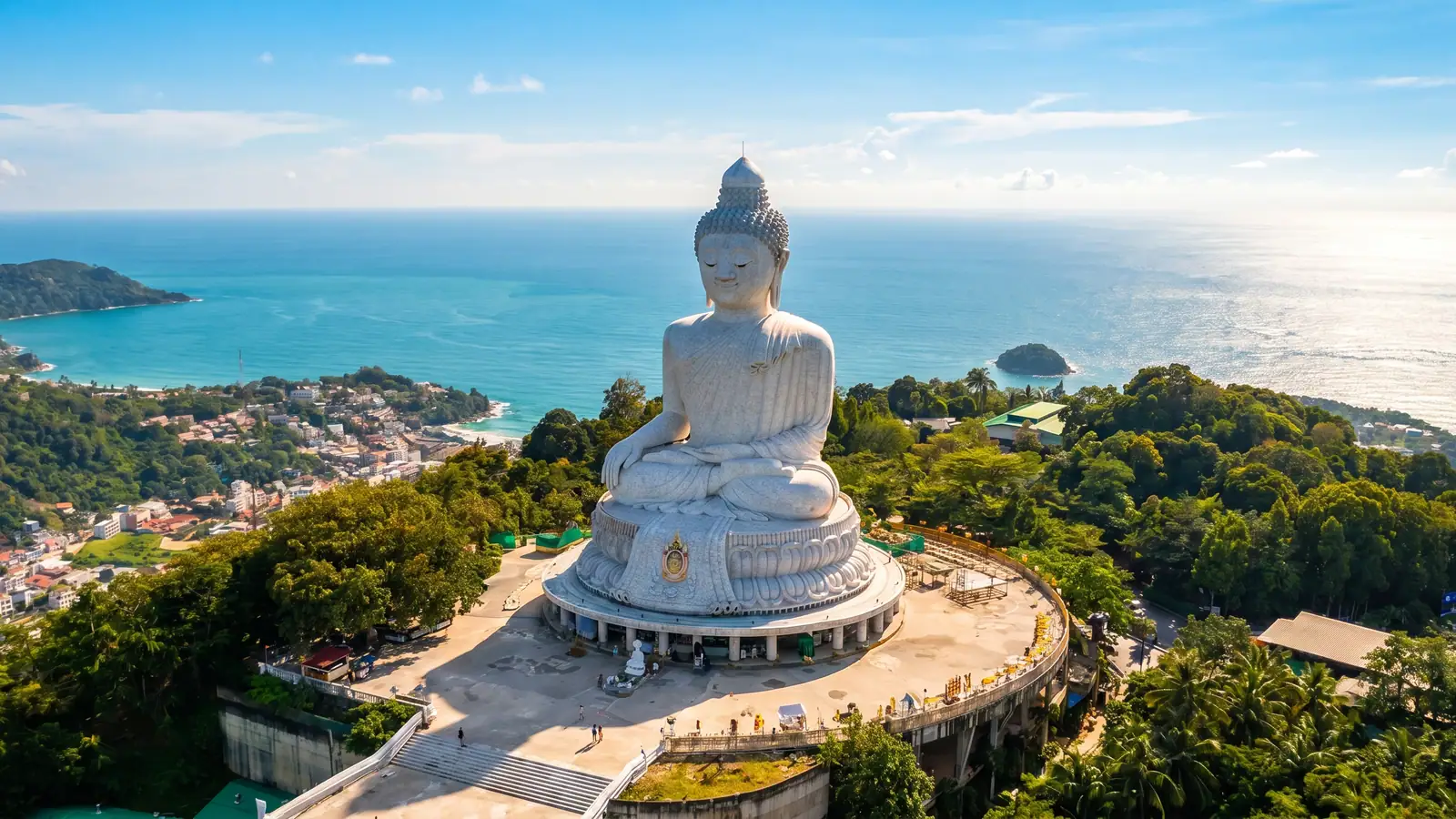
Here is why this does not undo the case for a 365-day reset. The work that changes your body, the training, the structured nutrition, the scheduled recovery, the coaching, happens sheltered from the elements and on a fixed plan regardless of the sky. What the weather affects is the optional outdoor extras: the open-sea kayak, beach workout, the Big Buddha hike. In the wet months those flex around the rain rather than disappearing. So the honest version is this: come any time and the reset works; come in the dry season and you also get the postcard. Either way, you are not gambling your results on the forecast.
The visa note you must check before you book
This is the one fact in this entire post you should not take from any blog, including this one, without re-checking it for your own passport on the day you book. Thai visa rules are changing.
As of a cabinet decision on 19 May 2026, Thailand approved cutting the visa-free exemption from 60 days down to 30 days for most of the roughly 93 affected nationalities, including the US, UK, Australia, Canada, and most of Europe. Important: as of writing, this is not yet in force. It takes legal effect only after publication in the Royal Gazette plus a 15-day grace period. A one-time extension of around 30 days at a local immigration office (roughly 1,900 THB) has historically been available to push a stay longer. A digital arrival card, the TDAC, is required and should be completed at least three days before you arrive.
Because this is genuinely in flux, do not plan a stay length around a number you read here. Check the current rule for your nationality before you book, and confirm it again close to departure. We will help you understand what your program length means for your entry, but the official rule is the one that counts.
How Prime Revive is built for the cue-break
Everything above is true whether or not you ever book anything. If you would rather engineer your own environment swap with what you have just read, you now have the principle that matters: change the context, not just the intention.
Here is where a structured retreat earns its place. The cue-break only works if the new environment is actually built to remove decisions, not add them. A villa with a gym attached still leaves you making every choice yourself. That is the trap most "fitness holidays" fall into.
Prime Revive is a fully managed body transformation retreat. We book the whole thing for you, the training, the food, the recovery, the accommodation, the coaching, so the hundred small decisions that defeat you at home are made in advance. It runs on four integrated pillars, and the point of all four is the same: take the decision off your plate so the right choice is the default.
Training is coached and programmed to you, not pulled from a template, and built around the change you actually came for. A Prime Revive coach is in every session with you, so you are never guessing what to do or whether you are doing it right. Your week is set in advance: two one-to-one personal training sessions, group strength and conditioning, a Muay Thai session, beach workouts, and a weekly Big Buddha hike, across the gyms on Fitness Street. If you can walk, you can start, because every session is modified to your body, your injuries, and your level.
Nutrition is handled through Pure Prep, our meal partner minutes from your door. Two calorie and macro counted meals a day, plus a protein shake and a snack, prepared for you. No weighing, no logging, no guessing. Your evening meal is the one you choose, within your targets, so you are learning to eat in the real world instead of following a rigid menu you could never repeat at home.
Recovery is scheduled, not optional. It is built into the week, not squeezed in if you feel like it: weekly massage, ice bath, sauna, yoga and stretching, and active recovery like a hike or a kayak. You recover on a plan because that is what lets you keep training week after week instead of breaking down in the first one.
Accountability is the structure that holds it together. Every week you get a 3D body composition scan and sit down with your coach to read it, so you are measuring what is actually changing, fat, muscle, and measurements, instead of chasing a single number on a scale.
None of this is willpower. It is environment design. You are dropped into a context where every cue points the same direction, the decisions are made in advance, and the easy path and the right path are finally one path. That is the whole reason it works when home did not.
We run all of it 365 days a year, so you join on whatever date your life allows, dry season or wet.
The version of you who actually went and did it
The reset is not really about the weeks you are here. It is about who you become while the old cues are switched off, and what you carry home once the new ones are installed.
You already know the person you keep failing to become at home. The one who finishes what they start. The one who took themselves seriously enough to actually go. The environment is the lever that finally makes that person the default instead of the exception.
If that is the want underneath all the false starts, here is the soft version of the next step. Tell us your goals and we will build you a free, personalised plan, no commitment, so you can see exactly what your reset would look like before you decide anything. Read more about the retreat in Phuket, or tell us where you are starting from.
You have run the home version enough times to know how it ends. This is the other variable. The one you have never actually changed.
FAQ
Why is Phuket good for a fitness or health reset specifically? The strongest reason is behavioural, not scenic. Around 45% of daily behaviour is cued automatically by your fixed environment, so removing yourself from that environment breaks the cues that trigger old habits, a documented effect called habit discontinuity. Phuket adds practical advantages on top: it concentrates serious gyms, coaching, and nutrition into one walkable street (Soi Taied, known as Fitness Street), it is highly accessible with direct flights to around 35 countries, living costs run roughly half of Western markets, and it has real nature for active recovery beyond the beaches.
When is the best time of year to visit Phuket for a retreat? The dry season, roughly December to March, gives the calmest seas and the most settled days (around 33C, with January and February driest). The wet season, roughly May to October, has two rain peaks, the heaviest around September and October. The core training, nutrition, and recovery work runs indoors on a fixed plan year-round, so any date works; the season mainly affects optional outdoor activities like open-sea kayaking and beach running.
Do I need a visa to visit Phuket for a retreat? Rules are changing and depend on your nationality, so verify the current rule for your passport before booking. As of a 19 May 2026 cabinet decision, Thailand approved reducing visa-free entry from 60 to 30 days for most Western nationalities, but it is not yet legally in force pending Royal Gazette publication plus a 15-day grace period. A one-time extension at a local immigration office has historically been available, and a TDAC digital arrival card is required. Always re-check official sources close to departure.
Is going abroad to get fit just an expensive holiday? It can be, if the environment simply relocates your decisions somewhere prettier. The difference with a structured reset is that the new environment removes the daily decisions willpower keeps losing, what to eat, when to train, whether to recover, rather than adding them. When the easy choice and the right choice become the same choice, you are no longer relying on discipline, and that is what a holiday cannot do.
Specific guest results referenced anywhere on this site are individual cases, not predictions or averages. Health and fitness outcomes vary by person.